
Apple has lost me as an enthusiast customer
I find myself feeling about the Studio Display XDR the same way I do about the Vision Pro. It’s a high-priced product on the leading edge of what is possible with mass-market consumer electronics. I am directly in the target market. This feels made for me. But the fact that its value is limited by strict “walled garden” constraints imposed by Apple makes me not able to justify the purchase.
Five years ago I made a risky bet on my desktop display – a 4K OLED TV. The downsides of that decision have been a daily impediment to my work for about half that time, while I waited patiently for Apple’s next premium display to replace it. Apple’s new Studio Display XDR should be the monitor I’ve been waiting for. Instead, my money is going elsewhere.
The down side of OLED
Permalink to The down side of OLEDIn 2020 I bought an LG CX 48-inch 4K OLED TV, which at the time was hailed as a bit of a wonder: a leading-edge OLED panel, capable of full HDR (including Dolby Vision), perfect blacks, and frame rates up to 120Hz, all in a unit small enough (just!) to fit on a desk. I could also connect it to gaming consoles and other video sources – a versatile and top-quality display for anything I might want, right there on my desk.
The 4K resolution is definitely a liability at that size. I have effectively been using macOS without Retina resolution on my primary display this whole time. But the idea that my macOS desktop could spread out in front of me on a canvas large enough for me to forget that it has edges, and I could hang application windows freely in that wide, open space in front of me was seductive. Indeed, this is the same “vision” that underpins Apple’s own foray into “spatial computing”, Vision Pro.
At first, sub-Retina resolution aside, it worked wonderfully. The only real issue I encountered was the TV’s own attempts to preserve the health of its OLED panel: the picture would gradually dim down to a nearly unusable level if the TV detected what it considered a “static” image. In practice, this meant I had to grab a window and wave it around the screen every few minutes, to trigger the TV to return to full brightness. Soon, however, users like me discovered that a trip into the TV’s service menu could disable this auto-dimming behaviour, though of course this came with a risk of OLED burn-in.
At the time, well-meaning folks on web forums reassured me that burn-in wouldn’t be a problem as long as I kept my Mac’s screensaver and display sleep features enabled. It would take leaving a static image on the screen overnight to do any real damage.
In practice, they were wrong. After a couple of years, burn-in became unmistakeable: bright vertical strips in the display corresponding to common positions of window edges, drop-shadows, and other usually-dark elements. At the same time, the centre of my screen gradually began to discolour, since it displayed content with bright backgrounds (like web pages) much more often than the edges of the display. Here’s what this looks like today:
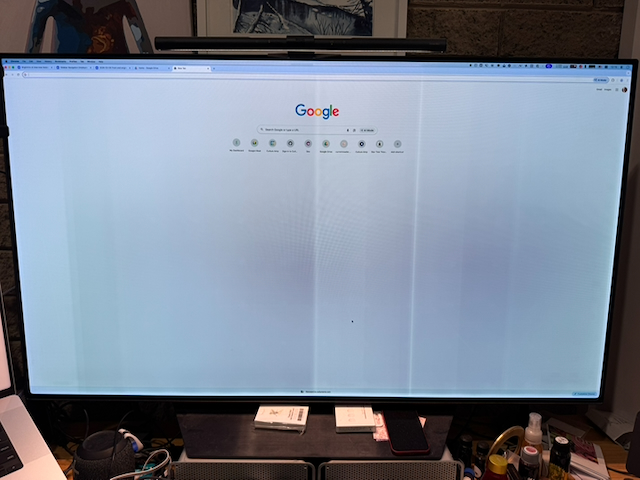
As my daily view of my work has steadily clouded, I’ve waited along with the rest of Apple fandom to see what the company would release to follow the beautiful, but long-in-the-tooth Studio Display (2022). Ideally, I hoped, it would deliver something like the size and picture quality of its 32" 6K Pro Display XDR (now discontinued) at a price point more accessible to enthusiast users like me, if not the masses.
Apple’s new window is a wall
Permalink to Apple’s new window is a wallThis week, Apple raised the curtain on a pair of new displays: a slightly updated Studio Display, and a new Studio Display XDR (27-inch). Though it doesn’t have the 32-inch size that might have preserved the “edgeless canvas” experience that I still love, this monitor should nevertheless be for me: it’s got bright highlights and inky blacks nearly a match to an OLED panel (with only very slight blooming on high-contrast edges), the same amazing HDR colour depth and 120Hz refresh rate, all with Retina resolution – more than double the pixels-per-inch I’ve been living with. The price they’re asking is still high, but within reach for someone like me who stares at a monitor professionally and as a hobbyist for most of their waking hours.
So why am I not buying one? That’s where the Vision Pro comes in. I was extremely tempted to buy a Vision Pro at launch. Apple has designed it as a push into a new future for computer user experiences. I am a career user experience nerd, the exact kind of person Apple would want playing with this new product, building things for it in my spare time. As soon as I could, I took the in-store demo, loved every second of it, then went home and stared at the price tag. Ultimately, I could not justify it to myself. Not because I couldn’t afford it, but because it just wasn’t worth the asking price.
Let me be clear: I’m not saying Vision Pro is overpriced. The technology it contains is amazing, and every single dollar it costs can be seen and felt in the user experience it delivers. I’m sure Apple wishes it could offer it at a lower price, but I believe this is what this technology costs for now. No, that’s not the problem.
The Vision Pro can only run software approved by Apple, which has shown itself to be capricious and arbitrary in what it approves or rejects for its App Store. This model of software distribution fatally limits the product’s value. Who would have bought the original Macintosh if there wasn’t a thriving community of hobbyists and indie devs free to explore and push the bounds of what the hardware was capable of? Spatial Computing needs its “hackable”, experimental phase to find the killer apps of this form factor. I don’t see that happening in a world where every experiment needs to go through App Store approval.
Likewise, the Studio Display XDR seems like an exciting display, but you can only ever plug it into a Mac or an iPad. There’s no HDMI input, nor support for standard DisplayPort sources. Game consoles? Nope. Streaming boxes? Nope. Gaming PCs? Nope. I could justify investing in a screen of this quality if I could imagine using it for the next decade as the highest-quality display surface for any input I want to feed into it. But instead this product is locked down, limited to only the devices Apple will sell me. The utility just isn’t there to justify paying a “bleeding edge” price tag.
Leaving the orchard
Permalink to Leaving the orchardI wish Apple could see that open standards and low barriers to entry – not just beautiful walled gardens – are necessary to move the state of the art forward. It used to know that, and the enduring success of the Mac is testament to it. But the disruptive innovation that was iPhone seems to have made it forget this, as Apple has pursued the same business model for every new product since.
Meanwhile, I’ve just ordered a Kuycon G32P. It’s 6K at 32 inches, offering the size and resolution of Apple’s now-discontinued Pro Display XDR. It lacks both the HDR brightness and contrast and the 120Hz refresh rate of the Studio Display XDR, as well as webcam and speakers (neither of which I need), but it’s also half the price, includes both the stand and the VESA mount at that price (Apple makes you choose one), and can connect to just about any video source, with HDMI, DisplayPort, and USB-C inputs.
And as news breaks today that Google is opening up Android as a platform even more, I am closer now than I have been in fifteen years to buying something other than an iPhone for my next handheld computer.